硅酸盐学报论文撰写范例
时间: 分类:技巧指导 浏览次数:
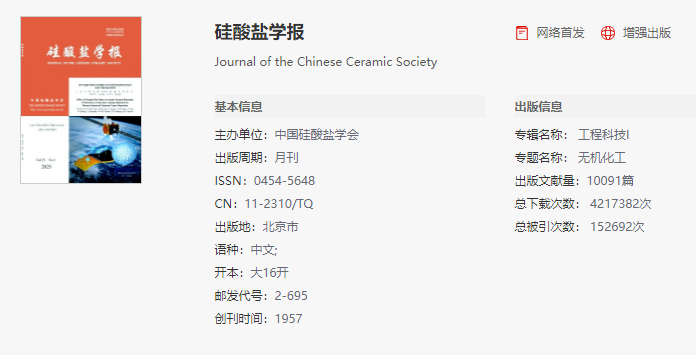
硅酸盐学报是北大核心,CSCD,EI收录刊物,由中国科学技术协会主管,中国硅酸盐学会主办,由《硅酸盐学报(中英文)》编辑部编辑出版,是无机非金属材料研究领域的综合性学术期刊。这本学报论文撰写要求严格,摘要和文章正文都有严格的要求,下面分享详细的撰写范例:
一、“英文长摘要”格式要求(综述)
1、篇幅:英文长摘要篇幅要求在800~1000字(单词数)。
2、结构:
(1) 题目、作者和单位(与中文信息对应的英文信息)
(2) 英文长摘要正文:
1)叙述本文研究领域的重要性和重要研究进展;
2)结论与展望(Summary and prospects)
(3) 关键词(Keywords)。
3、不要加参考文献。如果有引用其他文章,建议作者转述。
4、请删除原英文摘要。
5、“英文长摘要”题目中的单词首字母请大写(除介词外)。
6、 缩写首次出现时请用英文说明全称或者说明化学式。
7、“英文长摘要”请放在文末,参考文献列表之后。
二、“英文长摘要”格式要求(研究论文)
1、篇幅:英文长摘要篇幅要求在800~1000字(单词数)。
2、结构:
(1) 题目、作者和单位(与中文信息对应的英文信息)
(2) 英文长摘要正文:
1)研究目的(Introduction)(突出所做工作的重要性和必要性);
2)研究方法(Methods);
3)创新性结果(Results and discussion);
4)结论(Conclusions);
(3) 关键词(Keywords)。
3、不要加参考文献。如果有引用其他文章,建议作者转述。
4、请删除原英文摘要。
5、“英文长摘要”题目中的单词首字母请大写(除介词外)。
6、 缩写首次出现时请用英文说明全称或者说明化学式。
7、“英文长摘要”请放在文末,参考文献列表之后
三、两篇论文摘要范例:
文章1、原位反应法制备 Cr2AlC-Fe 复合材料
陈新华,翟洪祥,王文娟,黄振莺(北京交通大学,北京 100044)
摘 要:采用原位反应法制备了 Cr2AlC-Fe 系复合材料,并采用热分析、X 射线衍射、扫描电子显微镜和三点弯曲实验,研究了原位反应的烧结工艺对产物和显微结构的影响,以及对原料中 Cr2AlC 的含量对复合材料性能的影响。结果表明:通过高温原位反应,原料中 Cr2AlC 发生了分解,形成了网络状陶瓷增强结构,所制备的复合材料具有较好的强度和韧性,且随着 Cr2AlC 含量的增加,复合材料的强度也在增加,但断裂韧性逐渐下降。当Cr2AlC 的体积分数达到 30%时,复合材料的抗弯强度达 1 417 MPa。
关键词:复合材料;原位反应;烧结;弯曲行为
中图分类号:TB333 文献标志码:A 文章编号:0454–5648(2013)01–
Fabrication of Cr2AlC Fe-based Composites by in-situ Reaction Method
CHEN Xinhua,ZHAI Hongxiang,WANG Wenjuan,HUANG Zhenying
(Center of Materials Science and Engineering, School of Mechanical and Electronic Control Engineering,
Beijing Jiaotong University, Beijing 100044)
Abstract: A Cr2AlC-Fe composite, which could have potential applications in nuclear energy industry as engineering materials, was synthesized by an in-situ reaction method. The in-situ reactions between Cr2AlC and Fe at different temperatures and ratios were analyzed by thermogravimetric analysis-differential thermal analysis, X-ray diffraction and scanning electron microscopy, respectively.
The effect of s Cr2AlC content on the bending behaviors was investigated. The results show that Cr2AlC can in-situ react with Fe, and decompose to form chromium carbide. The synthesized composite exhibits a higher flexural strength and a greater fracture toughness at room temperature.
Key words: based composites; in situ reaction; sintering; bending behaviors
文章2、锰氧化物在水系电池中的研究进展与挑战
杜玲玉 1,毕嵩山 2,牛志强 2(1. 烟台大学环境与材料工程学院,山东 烟台 264005;2. 南开大学化学学院,天津 300071)
摘 要:水系二次电池因其安全性高、成本低以及对环境友好等特点,在大规模储能领域展现出广阔的应用前景。电极材料作为电池的关键组成部分,其性质直接影响电池电化学性能。锰氧化物具有晶体结构丰富、理论比容量高、氧化还原电位高、成本低等优势,被认为是最具发展潜力的正极材料之一。然而,锰氧化物存在导电性差、结构不稳定、锰溶解等问题,使电池面临倍率和循环性能差的严峻挑战,限制了其实际应用。此外,锰氧化物的反应机制较为复杂。
针对上述问题,本文通过调研有关锰氧化物的文献,首先分析了其晶体结构类型和特点,进一步按照电解液酸度梳理归纳了锰氧化物在(弱)酸性和碱性条件下的反应机制,简要阐述了其在水系碱金属离子、多价金属离子以及非金属离子二次电池体系的研究进展,最后对未来高性能锰氧化物正极的发展方向进行了展望。
关键词:水系电池;锰氧化物;晶体结构;反应机制
Progress and Challenges of Manganese Oxides in Aqueous Rechargeable Batteries
DU Lingyu1, BI Songshan2, NIU Zhiqiang2
(1. School of Environmental and Material Engineering, Yantai University, Yantai 264005, Shandong, China;
2. College of Chemistry, Nankai University, Tianjin 300071, China)
Extended Abstract
Aqueous rechargeable batteries have great prospects in the field of large-scale energy storage due to their high safety, low cost,and environmental friendliness. As a key component of batteries, electrode materials play important roles on their electrochemical performance. Vanadium oxides, manganese oxides, Prussian blue analogues, and organic materials are often used as active materials in aqueous batteries. Among these materials, vanadium oxides possess a variety of compounds, high theoretical specific capacity, andsuperior cycling performance. However, their redox potential is relatively low, restricting the operating voltage of aqueous batteries.
Moreover, these materials are toxic, which are not conducive in the large-scale applications. Compared with vanadium oxides,Prussian blue analogues have a higher redox potential and a stable structure, but they have some disadvantage of low theoretical specific capacity, resulting in the low energy density of batteries. In contrast, organic materials possess abundant sources, facile structure regulation, and superior sustainability. However, their poor conductivity and low compaction density make it difficult to
prepare high-loading electrodes. Compared with the materials above, manganese oxides have the advantages of diverse crystal structures, high theoretical specific capacity, high redox potential, non-toxicity, and low cost, which are beneficial for constructing high-performance aqueous batteries. Therefore, manganese oxides are considered as a promising electrode material in aqueous batteries. Recent efforts are made in the design of manganese oxides-based aqueous batteries, but the corresponding comprehensive review on this topic is still sparse.
This review firstly analyzed the crystal structure types and characteristics of manganese oxides. According to the connection mode between MnO6 units, the crystal structure of manganese oxides can be divided into one-dimensional tunneled structure (i.e.,α-MnO2, β-MnO2, γ-MnO2, R-MnO2, Todorokite-MnO2), two-dimensional layered structure (i.e., δ-MnO2), and three-dimensional spinel structure (i.e., λ-MnO2, Mn3O4, LiMn2O4, ZnMn2O4). The characteristics of corresponding crystal structure were summarized.
Manganese oxides exhibited unique physical and chemical properties, endowing their wide application as electrode materials in aqueous batteries.
The reaction mechanisms of manganese oxides are rather complex in aqueous batteries, especially for aqueous zinc-ion batteries, which were summarized according to the acidity of electrolytes. In alkaline Zn–MnO2 batteries, MnO2 is firstly converted into MnOOH, and then Mn(OH)2 is formed. As the acidity of the electrolyte decreases, manganese oxides exhibit different electrochemical reactions, mainly including ion insertion–extraction, conversion, and dissolution–deposition (Mn2+/MnO2). The
different electrochemical reaction mechanisms of manganese oxides provide plentiful energy storage chemistry for the design of aqueous battery systems. However, there are also irreversible side reactions and structural distortions in manganese oxides during the cycling process, which hinder their further development.
The application of manganese oxides in aqueous batteries is briefly elaborated, including alkaline-metal-ions (such as Li+, Na+),multivalent-metal-ions (such as Zn2+, Mg2+, Al3+), and non-metallic-ions (such as H+, NH4+) batteries. To address the poor conductivity, unstable structure, as well as manganese dissolution of manganese oxides, nanostructure design, hetero-element doping,defect engineering, and composite construction with other conductive materials are adopted to regulate the electronic structure and alleviate the Jahn–Teller distortion. As a result, the rate capability and cycling stability of manganese oxides-based aqueous batteries are significantly improved.
Summary and Prospects Although significant progress has been achieved in the design of manganese oxides for the electrodes of aqueous batteries, great challenges still remain in the scientific researches and practical application. The reaction mechanisms of manganese oxides are relatively complex, compared with those of other electrode materials. The reaction processes are also different for the same crystal structure. It is thus necessary to conduct the systematic and comprehensive investigation. The detailed structure evolution of manganese oxides could be revealed during electrochemical reaction process through some advanced in-situ characterization techniques (i.e., electrochemical quartz crystal microbalance, cryo-electron microscopy, X-ray photon-electron spectroscopy). The poor structure stability and manganese dissolution of manganese oxides result in the capacity attenuation uponcycling.
The precise structure optimization strategies are urgently needed to suppress the Jahn–Teller distortion and enhance structural stability, such as interface interaction regulation through introducing carbon materials and other functional materials into the composites, valence state adjustment of manganese elements through anionic doping. Furthermore, the development of novel electrolyte systems also plays a crucial role in the improvement of electrochemical performances for manganese oxides-based
aqueous batteries. High-concentrated electrolytes, molecular-crowding electrolytes, hydrated-eutectic electrolytes, and organic/inorganic hybrid electrolytes could reduce free water content and water molecule activity, regulate the solvation structure,which would be beneficial for suppressing manganese dissolution and promoting reaction kinetics. In addition, the diverse reactions of manganese oxides could be also utilized by adjusting the pH value of the electrolytes, thus developing the electrochemical energy
storage devices with a high voltage, high capacity, and high rate capability. The electrochemical performance of manganese oxide electrodes with a high mass loading could be improved by the synergistic effect of material structure design and electrolyte optimization. Finally, some controllable methods of manganese oxides in a largescale could be further developed for the industrial application of aqueous batteries.
Keywords aqueous batteries; manganese oxides; crystal structure; reaction mechanism
上述就是硅酸盐学报论文撰写范例,这本学报主要报道水泥基材料、陶瓷、玻璃、耐火材料、人工晶体、矿物材料、新能源材料、复合材料等相关领域的创新性科学研究成果。同时也被Scopus数据库、英国《科学文摘》、美国《化学文摘》、俄罗斯文摘杂志等收录,是大家值得投稿的刊物。
核心期刊投稿指南 专业指导快速发表
最新期刊论文咨询
- 浏览量:810山西省中专评正高级教师发表SCI算核心吗
- 浏览量:716论文参考文献有两篇是投稿期刊自引有问题吗
- 浏览量:380检索收录证明是见刊前就能搜到吗
- 浏览量:620南京农业大学毕业论文综述多少字数和格式
- 浏览量:689辽宁省机械类副高级职称评审条件
- 浏览量:715黑龙江省水利高级职称需要论文吗
- 浏览量:769中小学(幼儿园)老师晋升高级教师教育教学科研要求
- 浏览量:664学术博士申请必须有论文吗?发几篇?
- 浏览量:510口腔医学技术论文参考文献34篇
- 浏览量:632硕士学位论文参考文献格式分享
SCI核心期刊推荐
-

-
Scientific Reports
数据库:SCI
ISSN:2045-2322
刊期:进入查看
格式:咨询顾问
-
-
ACTA RADIOLOGICA
数据库:SCI
ISSN:0284-1851
刊期:进入查看
格式:咨询顾问
-

-
Materials Today Communications
数据库:SCI
ISSN:2352-4928
刊期:进入查看
格式:咨询顾问
-

-
PLANT JOURNAL
数据库:SCI
ISSN:0960-7412
刊期:进入查看
格式:咨询顾问
-

-
APPLIED SURFACE SCIENCE
数据库:SCI
ISSN:0169-4332
刊期:进入查看
格式:咨询顾问